
Demolition projects are among the most dust-intensive activities in the construction industry. Whether it is the dismantling of old residential buildings, industrial plants, or large commercial structures, demolition releases massive amounts of fine particulate matter into the air. If not properly controlled, this dust can spread far beyond the site boundary, affecting nearby communities, workers, and the surrounding environment.
In recent years, stricter environmental regulations and growing public awareness have made dust control a critical part of demolition planning. Among the various technologies available today, dust suppression cannon systems have become one of the most effective and widely adopted solutions for large-scale demolition dust control.
This article explores the key challenges of dust control in demolition projects, explains why effective dust suppression systems are essential, and shows how dust suppression cannons can deliver reliable and compliant results on real job sites.

Unlike routine construction activities, demolition releases large volumes of dust within a very short period. Crushing concrete, breaking masonry, and collapsing structures all generate fine particles that can remain airborne for long durations.
Demolition dust often contains cement, silica, and other fine materials. These particles are lightweight and easily carried by wind, spreading beyond the demolition zone and creating off-site pollution.
Many demolition projects take place in densely populated areas. Nearby residents, schools, hospitals, and businesses are directly affected if dust is not properly managed.
As demolition progresses, dust sources shift constantly. Fixed dust control systems may struggle to adapt to these changing conditions without flexible solutions.
The Importance of Effective Dust Suppression in Demolition
Prolonged exposure to demolition dust can lead to respiratory issues and long-term health risks. Effective dust control helps protect workers on site and reduces health-related downtime.
Environmental authorities often impose strict dust emission limits for demolition projects. Failure to comply can result in fines, work stoppages, or project delays.
Visible dust clouds can lead to complaints from nearby residents and damage the contractor’s reputation. Proper dust suppression demonstrates environmental responsibility and professionalism.
Heavy dust reduces visibility, making operations more dangerous and slowing down demolition work. Clear air improves coordination and overall productivity.
Water hoses and basic sprinklers are commonly used due to their low cost. However, they require continuous labor and often fail to control airborne dust effectively.
Fixed pipelines with spray nozzles can provide consistent coverage, but they lack flexibility and may not reach higher or moving dust sources.
Water trucks are useful for ground dust but are less effective for airborne dust during structural collapse.
While these methods offer some level of control, they often fall short in large-scale or high-intensity demolition environments.
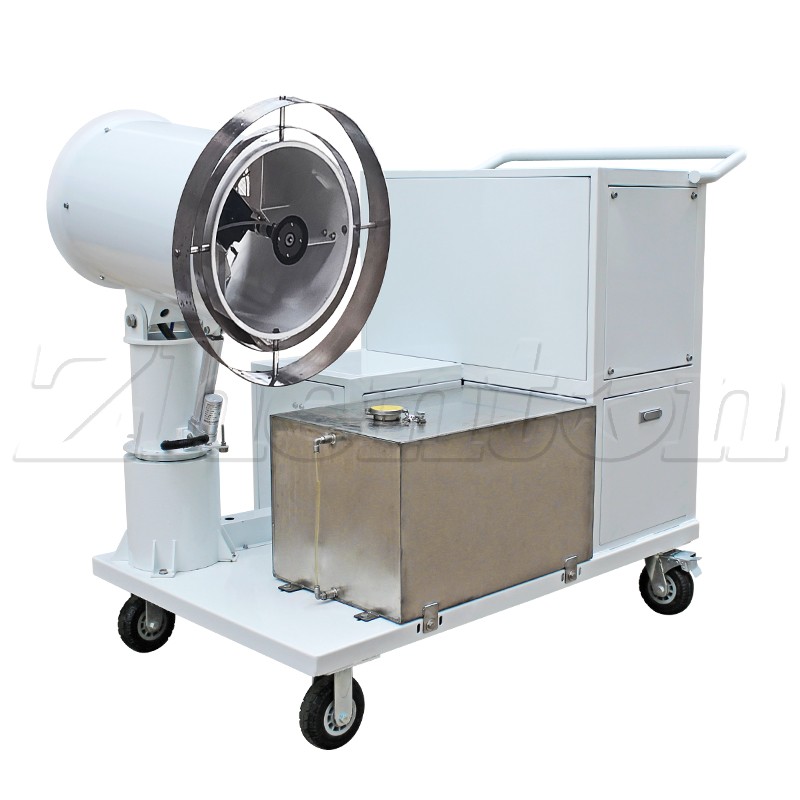
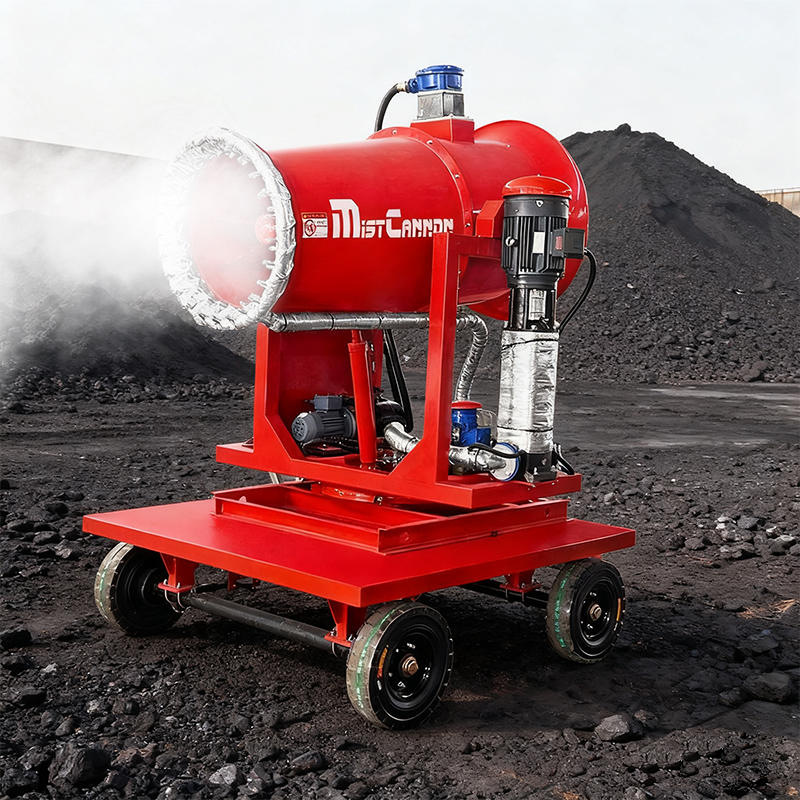
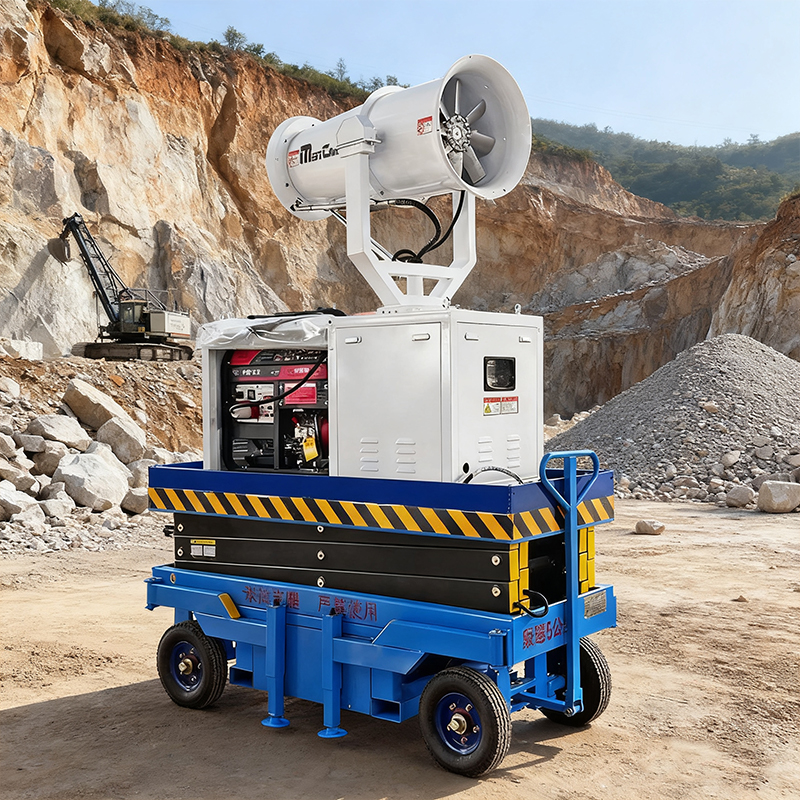
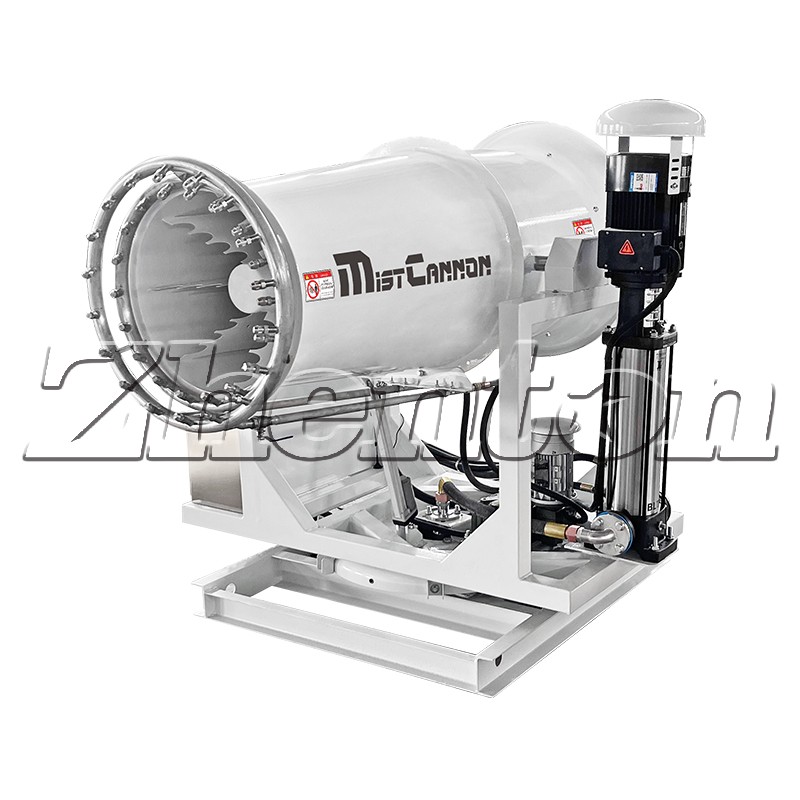
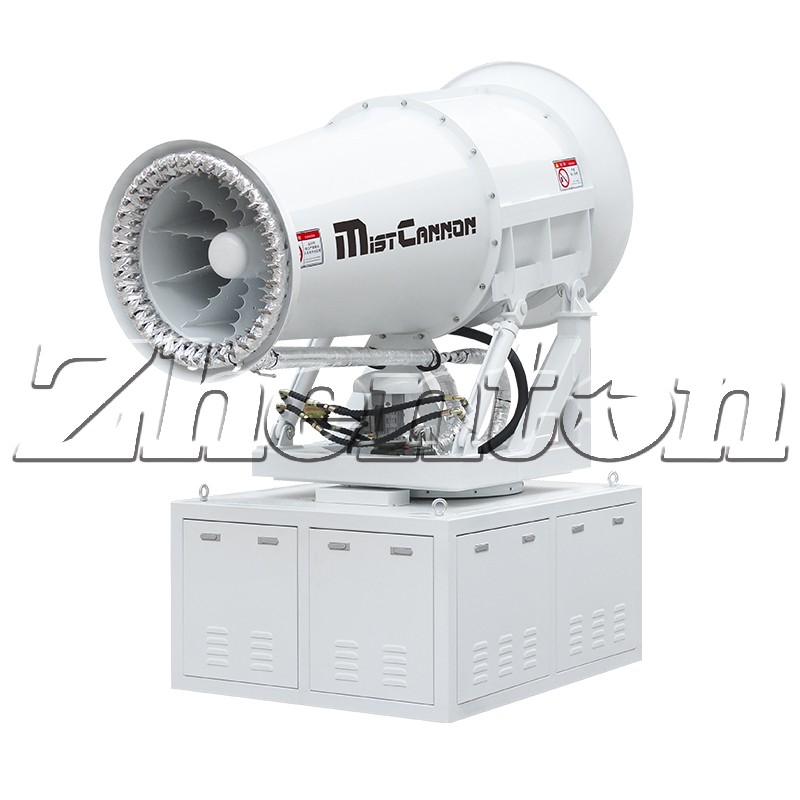
A dust suppression cannon is designed to control airborne dust by generating ultra-fine water mist and projecting it over long distances using a powerful fan system.
Water is atomized into micron-sized droplets
A high-efficiency fan propels the mist into the air
Fine mist particles bind with airborne dust
Dust becomes heavier and settles quickly
This process prevents dust from spreading and keeps it close to the demolition zone.
Long-Range Coverage
Dust suppression cannons can cover large areas from a single position, making them ideal for demolition sites with wide open spaces.
Flexible Deployment
Cannons can be installed as fixed units, trailer-mounted systems, or vehicle-mounted solutions, allowing easy relocation as the demolition progresses.
Reduced Water Consumption
Compared with traditional spraying, mist-based systems use significantly less water while achieving better dust capture.
Adjustable Operation
Spray angle, rotation range, and mist output can be adjusted to suit different demolition stages and weather conditions.
On-Site Application Example
At a large urban demolition site, a dust suppression cannon with a spray range of xx meters was deployed near the main structure collapse zone. The system was equipped with an xx kW fan motor, automatic oscillation, and a mist output of xx tons per hour.
During active demolition, the cannon continuously released fine mist, effectively capturing dust generated by concrete breaking and debris removal. Airborne dust levels were visibly reduced, and surrounding streets remained clear, helping the project meet local environmental requirements and avoid public complaints.
A: Yes. With proper adjustment of spray range and mist volume, dust suppression cannons can be used in large indoor spaces such as factories and warehouses.
A: Modern cannons feature adjustable angles and automatic rotation, allowing operators to adapt to moderate wind and maintain effective dust control.
A: No. The ultra-fine mist minimizes moisture impact while effectively suppressing airborne dust.
When selecting a dust suppression cannon for demolition projects, consider:
Proper system selection ensures maximum performance and cost efficiency.
Demolition projects present unique dust control challenges that require powerful, flexible, and reliable solutions. While traditional methods still play a role, dust suppression cannon systems offer a modern approach that combines long-range coverage, reduced water consumption, and adaptable operation.
By effectively controlling airborne dust, dust suppression cannons improve worker safety, protect surrounding communities, and help demolition contractors meet increasingly strict environmental standards. As demolition projects continue to grow in scale and complexity, dust suppression cannons are becoming an essential part of responsible and efficient site management.
Contact With Us
If you have any questions please fell free to contact with us.