
For decades, the standard response to dust on a Vietnamese construction site was simple: “Just spray some water.” But as the skylines of Hanoi and the industrial zones of Binh Duong expanded, so did the environmental consequences. Today, the “spray and pray” method is no longer legally sufficient.
The implementation of Decree 08/2022/ND-CP has fundamentally changed the landscape. It is the most comprehensive environmental protection decree in Vietnam’s history, and it places a direct, heavy responsibility on project owners and contractors to manage air quality. We aren’t just talking about keeping the ground wet; we are talking about maintaining strictly monitored PM10 and PM2.5 levels. For the modern Vietnamese contractor, failing to meet these standards isn’t just an environmental oversight—it’s a threat to the project’s bottom line.

Many site managers ask us: “What does the government actually expect?” Under Decree 08, the Ministry of Natural Resources and Environment (MONRE) has moved toward real-time accountability.
Strict Dust Emission Limits: The decree targets “diffuse dust emissions”—the kind generated by moving trucks, excavation, and crushing. If your site creates a visible dust plume that crosses the boundary of your property, you are already in violation.
Mandatory Mitigation Equipment: Contractors must prove they have “advanced technical measures” in place. A garden hose or a simple sprinkler is no longer classified as an “advanced measure.”
The Penalty Threshold: Fines for air pollution under the updated penal code can reach hundreds of millions of VND, and for repeat offenders, the government now has the power to suspend construction permits indefinitely.
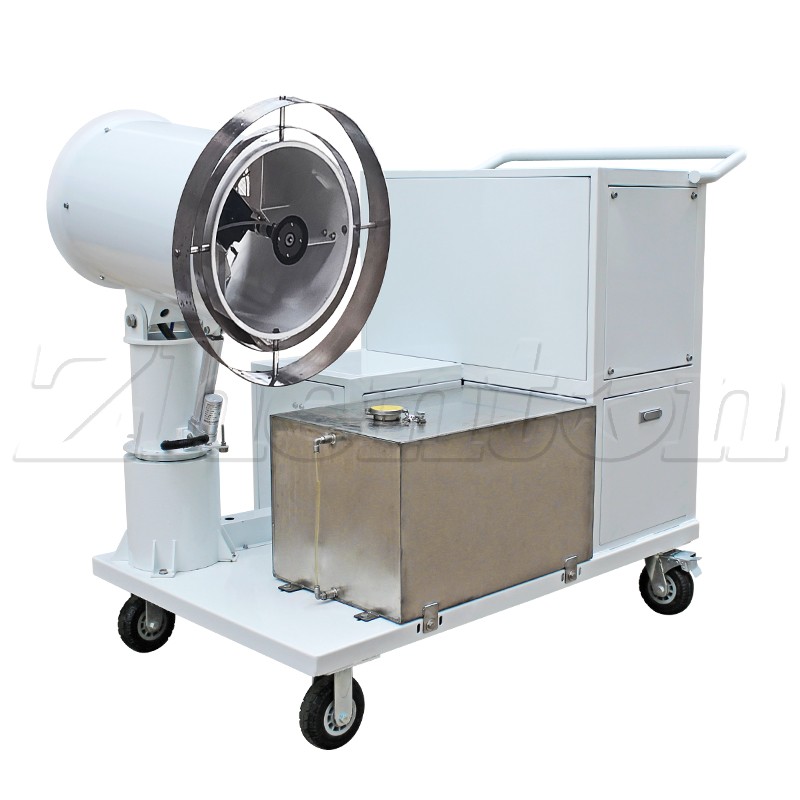
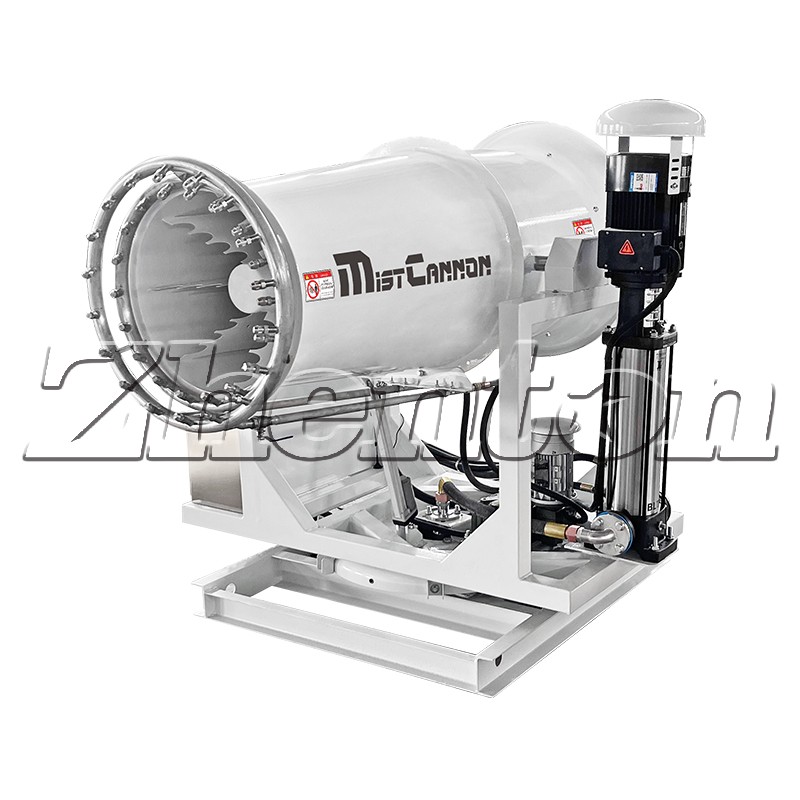
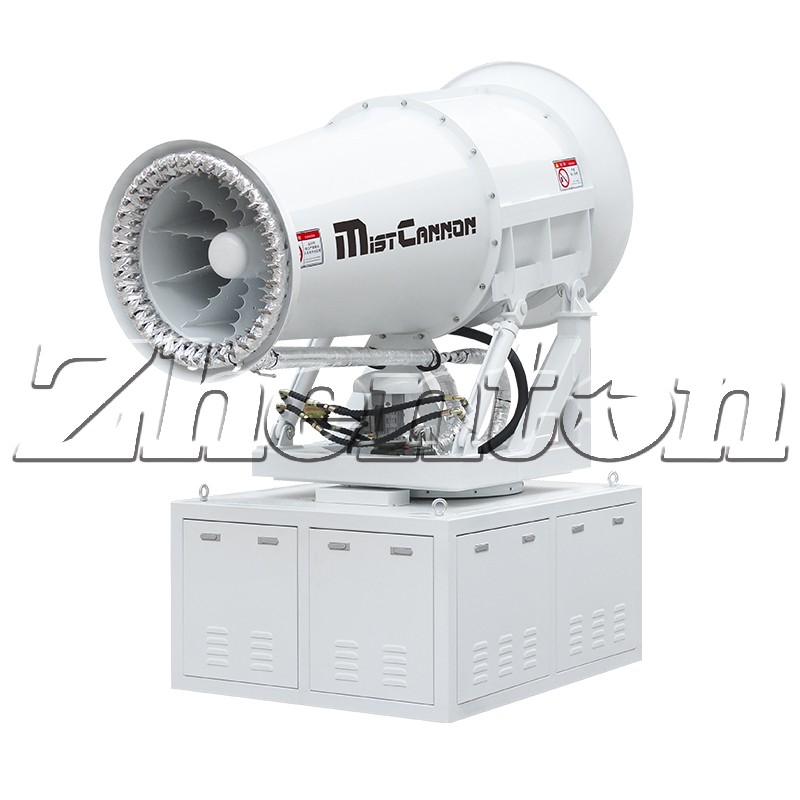
This is where the 60m Mist Cannon becomes your most valuable asset. It is the “Best Practice” solution that satisfies the rigorous requirements of Decree 08 by providing documentable, visible, and effective dust suppression.
To understand why the 60m mist cannon is the best tool for compliance, we have to look at the physics of dust. Decree 08 specifically mentions PM10 (coarse particles) and PM2.5 (fine particles).
Traditional water trucks create large droplets (usually 1,000 to 5,000 microns). A PM2.5 particle is tiny. When a large water drop meets a tiny dust particle, the “slipstream effect” occurs—the air current around the large drop pushes the tiny dust particle away. They never touch.
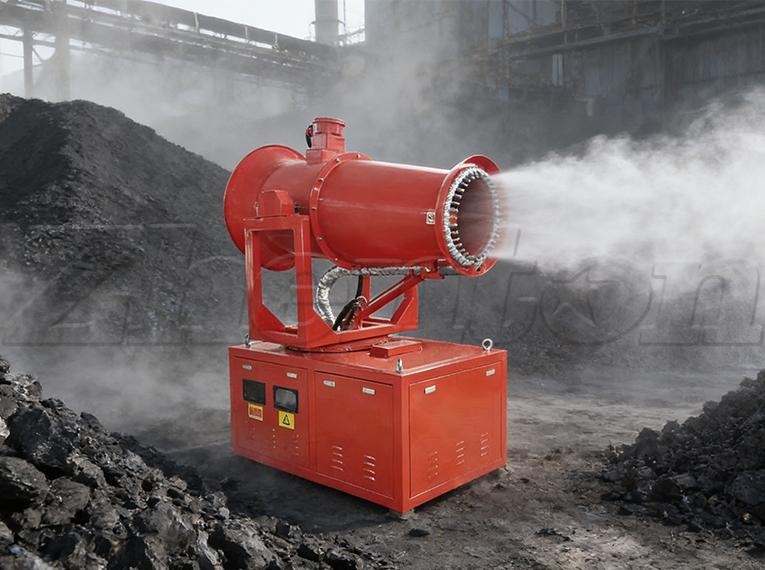
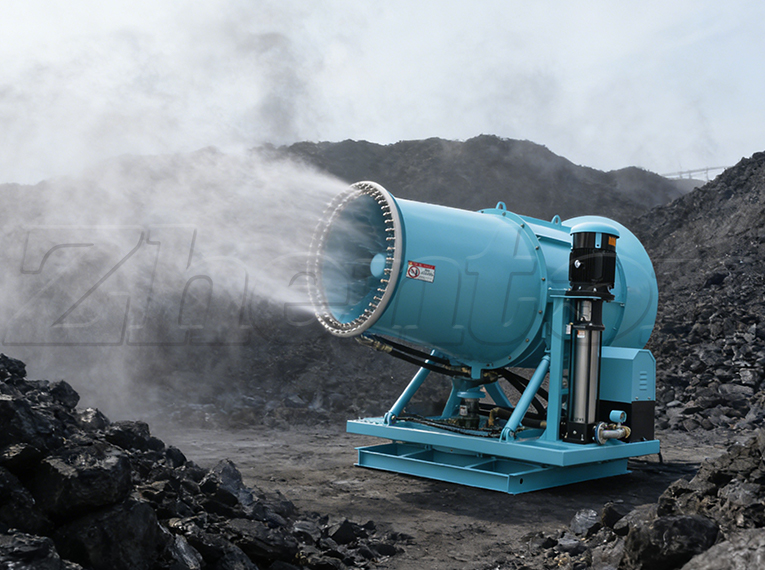
Our Zheng Tong 60m units utilize high-pressure atomization to create a “micro-mist” (10 to 150 microns). Because the mist particles are similar in size to the dust particles, they collide, bond, and fall to the ground through gravity. This is not just “wetting the ground”; this is scrubbing the air. When an inspector brings an air quality sensor to your site, this technology is the difference between a “Pass” and a “Fail.”
Meeting Decree 08 requires a strategy, not just a machine. Based on our 16 years of experience, we recommend a three-step compliance approach for Vietnamese sites:
Position the 60m cannon near the most active zones—such as the material crushing area or the main entrance/exit where trucks stir up silt. The 60-meter throw creates an “invisible wall” that captures dust before it can leave your site and trigger a complaint from the local community.
The modern Decree 08 environment favors data. Our cannons can be integrated with automated sensors. When the wind picks up or the air quality reaches a certain threshold, the cannon activates automatically. This proves to auditors that your site is managed by technology, not just human guesswork.
As the excavation moves, so must your dust control. The truck-mounted configuration ensures that your “Compliance Zone” moves with your work. Whether you are building a bridge in Da Nang or a factory in Hai Phong, your air quality protection is always exactly where the inspector expects it to be.
A: This is a common concern under Decree 08’s “clean site” requirements. Traditional watering often creates puddles and mud that trucks carry onto public roads. However, because our cannons use atomized mist, they use significantly less water while covering a larger area. The moisture evaporates or bonds with dust rather than pooling on the ground. You get a dust-free site without the mud-tracking penalties.
A: It’s better to think of it as “scalability.” A 60m cannon has adjustable rotation and spray intensity. While it can reach 60 meters, it can also be dialed back to cover a 20-meter zone more intensely. Buying a 60m unit ensures that as your contracts grow—from a small demolition to a massive infrastructure project—you won’t need to buy a second machine to stay compliant.
A: We provide full technical documentation, certificates of conformity, and noise/emission ratings for all Zheng Tong equipment. When you undergo an environmental audit, you can present these specs to show that you have invested in Best Available Technology (BAT), which is a major factor in reducing the severity of potential fines or obtaining project extensions.
At the end of the day, Decree 08 is about more than avoiding fines. It is about the transition of Vietnam’s construction sector into a global-standard industry. By choosing the best dust control measures—specifically the 60m truck-mounted mist cannon—you are protecting your workers’ health, respecting the local community, and ensuring that your company’s name is associated with quality and responsibility.
Clear the air. Secure your project. Stay compliant.
Contact With Us
If you have any questions please fell free to contact with us.