
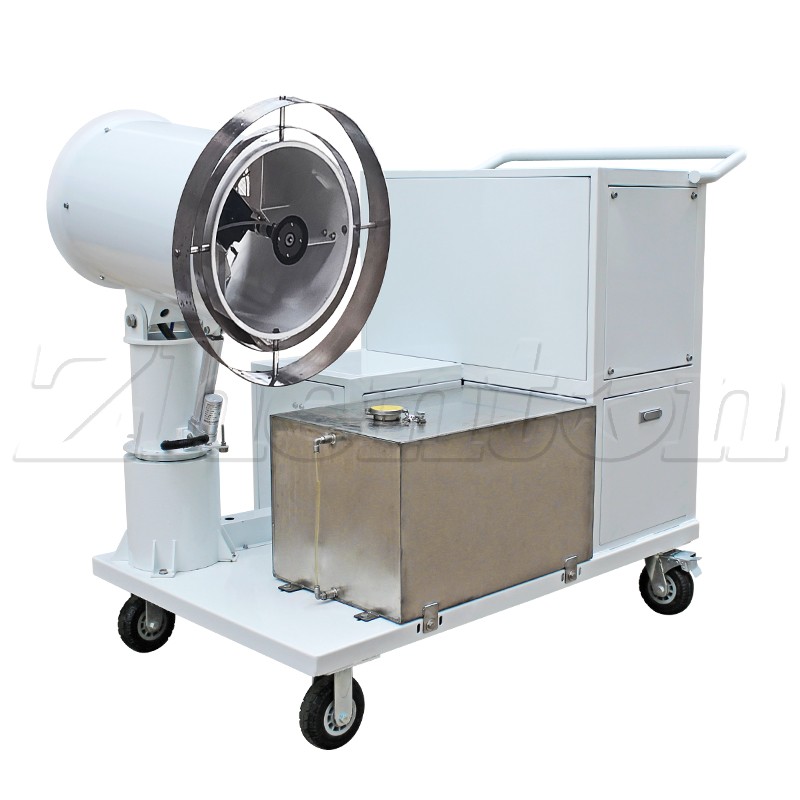
In the continuous cycle of urban development, demolition projects are an essential but hazardous undertaking. Demolition sites present two significant, intertwined challenges: safety risks, where dense dust clouds severely impair visibility and hinder equipment operation; and environmental compliance risks, where airborne particulates (PM10/PM2.5) from concrete, brick, and soil pose a direct threat to surrounding community air quality, leading to potential fines and project halts.
Traditional suppression methods, such as high-pressure hoses or manual spraying, are often inefficient, lead to excessive water consumption, and create hazardous standing water. Our Professional-Grade Mist Fog Machines offer a comprehensive solution for modern demolition—they are not merely sprinklers; they are precise aerial particle interceptors crucial for safety, efficiency, and compliance.

During heavy machinery operations, such as long-reach hydraulic shear or breakers, the instantaneous generation of large dust clouds is a primary cause of on-site accidents. Obstructed visibility can lead to equipment collisions, accidental injury to ground personnel, or deviation from the planned demolition path.
2.1. Precise Particle Matching:
Our fog cannon machine utilizes advanced atomization technology to convert water into tiny droplets, typically ranging from 30-150 in diameter. This size range is scientifically calculated to closely match the aerodynamic diameter of the dominant particulates in demolition dust (PM10), thereby maximizing collision, agglomeration, and settling efficiency.
Effect: The mist droplets rapidly attach to and encapsulate the airborne dust, pulling it out of the air and back to the ground in minutes.
Result: Visibility is instantaneously improved in the demolition zone, ensuring equipment operators can clearly see the working front, ground personnel, and site safety boundaries.
2.2. Mitigating Slip and Trip Hazards:
Unlike high-pressure washing or hose spraying, the mist fog machine’s output is carefully controlled to capture dust suspended in the air, not to saturate the ground. This prevents excessive water accumulation and muddiness on the site, significantly reducing the risk of slips, trips, and skids for both workers and heavy vehicles caused by slick surfaces.
Demolition workers are at high risk of developing occupational illnesses, such as silicosis, due to long-term exposure to dust containing crystalline silica and other heavy metals. This represents a significant social responsibility and legal liability for all demolition contractors.
3.1. Effectiveness Against PM2.5:
While the visible dust in demolition is mainly PM10, the most dangerous fraction is PM2.5 (respirable crystalline silica). The high-pressure atomization technology of our mist fog machines generates an abundance of fine droplets capable of capturing these hard-to-see, ultra-fine particulates. Continuous operation significantly lowers the workers’ Time-Weighted Average (TWA) exposure value to airborne particles in the work area.
3.2. Creating Clean Air Zones:
By strategically deploying the mist fog machine downwind and positioning smaller misting units near control cabins or break areas, a continuous “Clean Air Safety Zone” can be created. This not only directly safeguards worker health but also helps the company achieve favorable outcomes during inspections by regulatory bodies (e.g., OSHA or local health departments).
Q&A Segment 1: Addressing Throw Range and Mist Efficiency
Q: Demolition sites are often large and windy. Can a mist fog machine’s throw reach the entire zone, and won’t the mist evaporate before it hits the dust?
A: Our mist fog machine systems utilize Variable Frequency Drives (VFDs) and optimized axial fans, achieving effective throws of 50 to 100 meters, sufficient for typical urban demolition sites. The key is targeted suppression, not just broad coverage:
Targeting: Demolition dust sources are mobile and transient (e.g., structure collapse). The mist fog machine’s long throw and $360^{\circ}$ remote oscillation capability allow the operator to instantly and precisely direct the mist stream to the currently highest concentrated dust zone.
Evaporation Resistance: Our engineered droplet size ($50-150 \mu m$) balances momentum and evaporation rate. The droplets retain enough mass to travel to the target area, but once combined with dust, they settle immediately. Unlike finer “humidifying” mists that evaporate easily, our droplet design ensures a maximum effective contact time in the air where the dust is suspended.
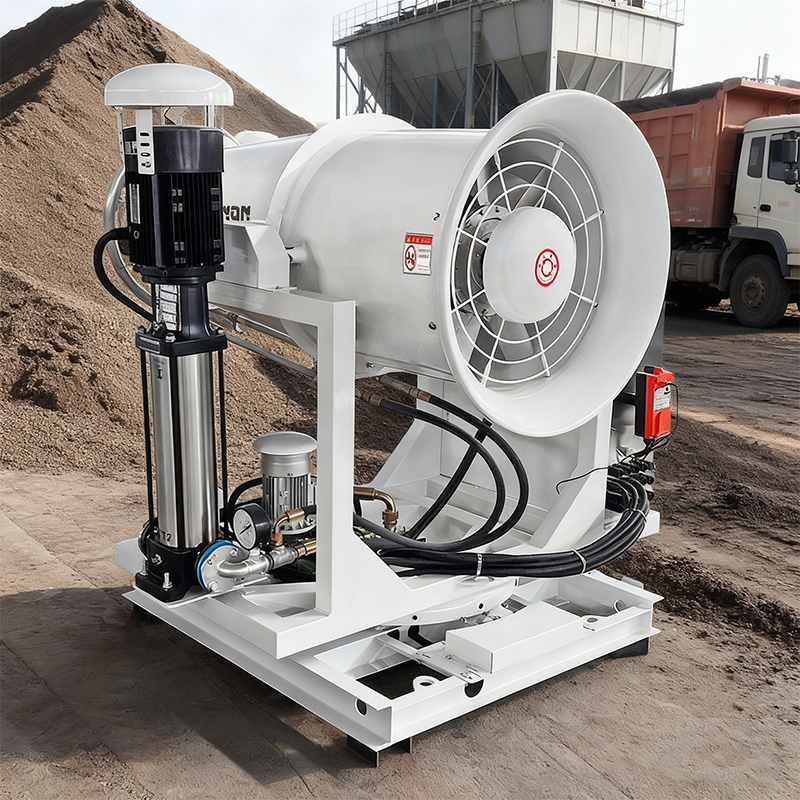
In the urban setting, dust migration rapidly escalates from an engineering issue to a socio-political concern. Neighbor complaints, media attention, and municipal fines can balloon project costs and lead to forced operational stoppages.
4.1. Avoiding Costly Fines and Shutdowns:
Many cities enforce strict thresholds for PM10 emissions. Once visible dust breaches the site perimeter, fines can amount to thousands of dollars per day. The mist fog machine ensures proactive, continuous boundary control, effectively locking dust within the worksite and minimizing environmental risk. This represents a quantifiable risk avoidance investment.
4.2. Enhancing Corporate Reputation:
Adopting advanced, environmentally friendly dust control technology signals a demolition contractor’s commitment to responsible operation. This not only helps foster community acceptance but also serves as a critical competitive advantage when bidding on large government or commercial projects that require high environmental standards.
Many perceive a mist fog machine simply as a large fan with a water source, but its design philosophy centers on conserving water and reducing operating costs.
5.1. Extremely Low Water Consumption:
Compared to high-pressure hoses that may consume tens of thousands of gallons per hour, the mist fog machine’s high-efficiency atomization can reduce water usage by 50% to 70%. This translates to:
Lower direct water costs.
Reduced strain on municipal water systems.
Reduced frequency of water tanker transport to the site, lowering traffic and carbon emissions.
5.2. Automation and Low Labor Requirement:
Modern mist fog machines support wireless remote control and timed, programmable operation. Operators can control the direction and volume of the spray from a safe distance, eliminating the need for dedicated personnel to manually hold water hoses for suppression. This frees up human resources for more critical demolition tasks, significantly improving on-site labor efficiency.
Q&A Segment 2: Addressing Noise and Urban Compatibility
Q: mist fog machines typically use high-power fans. In strict urban areas, won’t the noise become a new source of complaint?
A: This is a crucial factor addressed by our specialized Urban Elite Series mist fog machine, which is optimized through acoustic engineering:
Low-RPM, High-Pressure Fan: We employ a larger diameter, low-Revolution Per Minute (RPM) axial fan design that maintains high airflow pressure while significantly reducing aerodynamic noise.
Sound Damping: Key noise-generating components (like the motor casing) are mounted using vibration isolation pads and enclosed with sound-absorbing materials.
Noise Guarantee: Our equipment noise levels are typically kept below 75 dB at a 10-meter radius during standard operation, making them compatible with urban noise ordinances and significantly quieter than many primary demolition tools (e.g., breakers). Strategic placement away from the community boundary further minimizes the acoustic impact.

The variety of structures subject to demolition requires dust suppression systems to be highly adaptable.
6.1. Adverse Weather Adaptability:
In windy conditions, the machine’s high-thrust airflow effectively counteracts crosswinds, ensuring the mist is delivered to the target zone. For cold climates, we offer optional anti-freeze heating packages and automatic draining systems to ensure the equipment starts and runs reliably in winter, preventing water line damage from freezing.
6.2. Additive Functionality:
Beyond dust control, the mist fog machine can be equipped with a specialized dosing pump to inject odor neutralizers for demolition projects involving waste, sewage, or materials like asbestos, providing an additional layer of environmental management.
Q&A Segment 3: Long-Term Maintenance and Return on Investment (ROI)
Q: mist fog machines seem like high-tech equipment. Is the maintenance costly, and how quickly can we expect a return on investment (ROI)?
A: Compared to the cost of continuous fines and high labor input, the ROI period for a mist fog machine is typically very short:
Low-Maintenance Design: Our equipment features a modular design with minimal wear components. The primary maintenance involves the water system—regular cleaning and replacement of water filters to prevent clogging of the micron-level nozzles. The nozzles themselves utilize durable ceramic or stainless steel inserts.
Rapid ROI: Investment payback is realized through:
Avoidance of Major Fines: A single severe dust violation fine can often cover the cost of one unit.
Efficiency Gains: Reducing water truck and manual labor operating costs, accelerating project timelines.
Risk Reduction: Lowering worker occupational health risks, decreasing long-term liability, and insurance premiums.
Most of our demolition clients achieve a net return on their equipment investment within 12 to 18 months.
In today’s stringent regulatory environment, the mist fog machine is no longer a luxury on a demolition site—it is the hallmark of safe operation and environmental responsibility. Choosing our professional-grade mist mist fog machines is choosing a complete solution that effectively manages risk, safeguards employee health, and ensures project completion on time and in full compliance.
Contact With Us
If you have any questions please fell free to contact with us.